Cart is empty.
Item Quantity Price Total: $0

Battery Operation of MINI-MAX Boards
Powering microcontroller boards from a battery is useful in situations where a mains power source is not readily available or power is intermittent ( for example, when powering from a solar cell, the power is available only during the day ).Our MINI-MAX boards are low-power microcontroller boards that allow battery powered operation.
The current consumption of MINI-MAX boards are typically under 50mA. This amount can be reduced further by putting the microcontroller in idle mode when not in use.
Power Budget of MINI-MAX/51-C2:
| Component | Current (Normal Mode) |
Current (Idle Mode) |
Current (Powerdown Mode) |
|---|---|---|---|
| AT89C51ED2 | 13mA | 11mA | 75uA |
| Secondary microcontroller | 1.5mA | 1.5mA | 1.5mA |
| RS232 Transceiver | 3mA | 3mA | 3mA |
| Regulator | 2mA* | 2mA* | 2mA* |
| Voltage reference | 100uA | 100uA | 100uA |
| Total: | <20mA | <20mA | <7mA |
* The regulator has a typical quiescent current of 2mA. Worst case quiescent current is 10mA over the full temperature range.
Power Reduction Tips and Tricks:
- Put the microcontroller in IDLE mode when not in use. An interrupt can take the microcontroller our of IDLE mode.
- If you application allows it, put the microcontroller in POWER DOWN mode. Only a RESET cane take the microcontroller out of POWER DOWN mode. In the case of MINI-MAX boards, this is possible because there is a second, supervisory microcontroller on the board. The watchdog of the supervisory microcontroller can be programmed to generate a reset periodically to take the main microcontroller out of POWER DOWN mode, perform a useful action and go back to POWER DOWN mode.
- Set the unused port pins to logic HIGH state. Some of the microcontroller port pins have pull-up resistors that contribute to the current consumption if the port pins are logic LOW.
- If you need an ultralow power version of MINI-MAX boards, please contact BiPOM Electronics. We can produce a version of the board with ultralow power regulator, ultralow power transceiver and ultralow power secondary microcontroller to really minimize the total current consumption down to few mA.
Battery power level monitoring
MINI-MAX/51-C2 has 5 channels of analog inputs on-board. These can be used to monitor the voltage level of the battery to estimate the remaining battery life until next recharge. The analog inputs can only measure voltages in the range of 0 to 4.096 Volts so an external resistive divider should be used to connect the battery to the MINI-MAX/51-C2 analog inputs. Diagram
Battery Connection Options:
We provide some pre-manufactured cables to simplify battery operation of our boards:

CBL-9V
Power jack adapter for 9V Batteries. CBL-9V allows powering MINI-MAX and PRO-MAX Series Microcontroller Boards from a standard 9V Battery.

CBL-CAR
Power Jack adapter for Car Cigarette Lighters. CBL-CAR allows powering MINI-MAX and PRO-MAX Series Microcontroller Boards from a automobile or other vehicle.
Powering from AA or AAA batteries
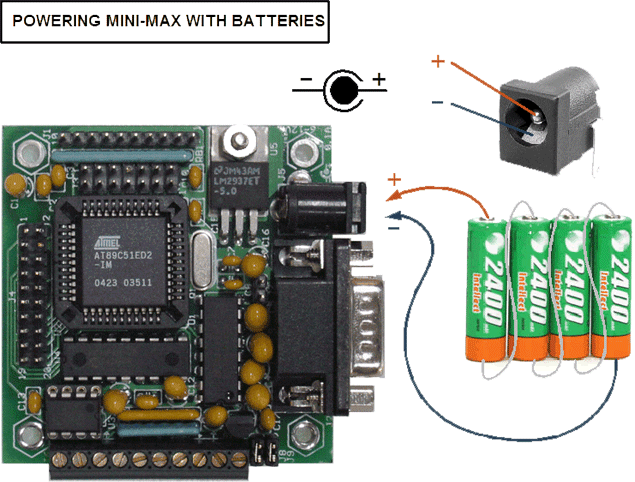
Both MINI-MAX and PRO-MAX boards have a low voltage dropout regulator which allows reliable operation down to 6 Volts ( or even less depending on the current consumption ). This means 4 or 5 AA or AAA batteries can power these boards. You can connect the batteries as shown:
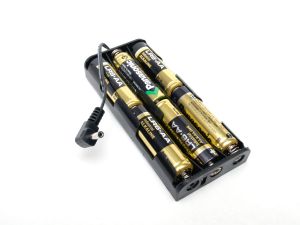
Alternatively, you can buy a readily available battery pack to avoid the effort to prepare the battery pack yourself: